Information Management Is a Function, Not a Job Title
- Entry
- LAB-0005
- Rev
- R01
- Origin
- Research
- Date
- 2026-11-30
Raul Alvarez · Founder, Datum AEC · November 30, 2026 · Updated November 30, 2026
A tender asks you to name the people who will manage the project's information. What do you write on the form? The UK guidance on tendering says that some firms have put a job title there, such as "BIM manager" (IMI Framework Guidance E, § 4.5.3). The standard asks a different question: who does each task, and who answers for it.
I have read Parts 1 and 2 of ISO 19650 and the UK guidance on the information management function. Here is what they say on three points: who does the work, who is accountable for it, and what to decide before you hand it to someone else.
The standard assigns activities, not roles
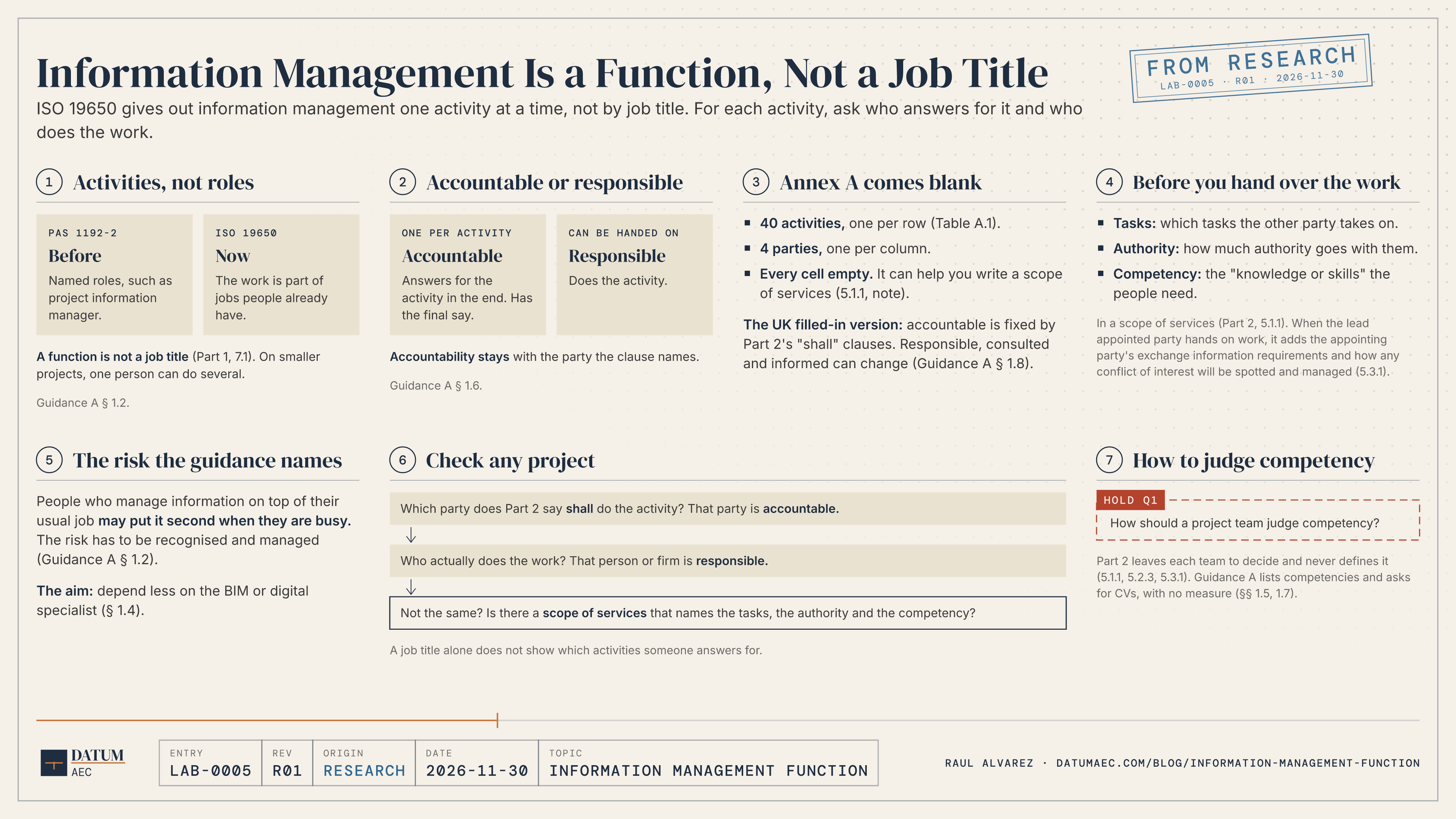
Part 1 says it plainly: a function is not a job title. It is not a professional title either (ISO 19650-1, clause 7.1). The same clause says two things about smaller projects. One person can do several functions. And information management can be done alongside other work, such as project management.
The UK guidance compares this with what came before. PAS 1192-2, the older UK specification, created named roles, such as project information manager and task information manager. ISO 19650 drops those roles. It expects the work to be part of the jobs people already have (IMI Framework Guidance A, § 1.2).
Part 2 asks the bidding firm to use its tender to propose the names and CVs of the people who will do the work (ISO 19650-2, clause 5.3.2 a). Guidance E calls this move from roles to tasks a key change: people get clear tasks, not roles with no clear limits (§ 4.5.3).
Accountable and responsible are not the same thing
Guidance A gives two words different meanings (§ 1.6):
- Accountable: the organization that answers for an activity in the end. It has the final say on that activity. Each activity has only one accountable organization.
- Responsible: the organization that does the activity.
You can hand responsibility to someone else. Accountability stays with the party the clause names. Almost every activity in Part 2 starts by naming who shall do it: the appointing party, the lead appointed party, or each task team. One activity names the whole delivery team (clause 5.6.5). The post on five ISO 19650 terms explains who these parties are.
The appointing party also stays accountable overall for giving the function to its lead appointed parties. The guidance says it should check that the work really gets done (§ 1.2).
Annex A comes blank
Part 2 ends with a table for deciding who does what in each activity: a responsibility matrix (Table A.1). Each row is one of the 40 activities of the delivery process. Each column is one of four parties: appointing party, third party, lead appointed party and appointed party. The key defines four words: responsible, accountable, consulted and informed. Every cell is empty. A note at clause 5.1.1 says the table can help you write a scope of services when you hand the function to someone else.
The UK framework publishes a filled-in version, as the first post in this series mentions. Its instructions repeat the rule. Part 2's "shall" clauses fix who is accountable, and that should not change. Who is responsible, consulted and informed can change to suit the project (Guidance A, § 1.8).
Three things to decide before you hand over the work
Part 2 lets the appointing party hand all or part of its function to another party. That can be a prospective lead appointed party (a firm bidding to lead a delivery team) or a third party. If it does, it shall write a scope of services and consider three things (clause 5.1.1):
- Tasks: which tasks the other party takes on.
- Authority: how much of its authority goes with those tasks.
- Competency: the "knowledge or skills" the people doing the work need.
The same test applies when the lead appointed party hands on work (clause 5.3.1). It adds two items: the appointing party's exchange information requirements (its information requirements for that appointment), and how any conflict of interest will be spotted and managed (Guidance A, § 1.6). If one firm runs the function for the appointing party and for itself, Part 2 recommends different people for each.
The risk the guidance names
Adding the function to existing jobs has a cost, and Guidance A names it. People who manage information on top of their usual job may put it second when they are busy. The guidance says this risk has to be recognised and managed (§ 1.2). It also says why it spreads the tasks across the team: to depend less on the BIM or digital specialist, and to build the skills into the jobs people already have (§ 1.4).
Back to the tender form
The tender form wants the names of the people who will do the work. Part 1 says a function is not a job title. So a title alone does not show which activities someone answers for. Here is one way to apply the clauses to any project:
- For each activity, which party does Part 2 say shall do it? That party is accountable.
- Who actually does the work? That person or firm is responsible.
- If they are not the same, is there a scope of services? Does it name the tasks, the authority and the competency?
Part 2 leaves each project team to decide how to judge competency. Part 2 asks for it when work is handed over and when tenders are judged, but it never defines it or says how to measure it (clauses 5.1.1, 5.2.3 and 5.3.1). The UK guidance lists the competencies to consider, technical and non-technical. It also asks a third party bidding for the work for CVs (Guidance A, §§ 1.5 and 1.7). But it gives no way to measure them either.
On the projects you know, who is accountable for information management? Does their job title match?
Claude helped me research and draft this post. The judgment and the voice are mine.