Appointing Party May Not Be the Client: Five ISO 19650 Terms
- Entry
- LAB-0004
- Rev
- R01
- Origin
- Research
- Date
- 2026-11-25
- Topic
- ISO 19650
Raul Alvarez · Founder, Datum AEC · November 25, 2026 · Updated November 25, 2026
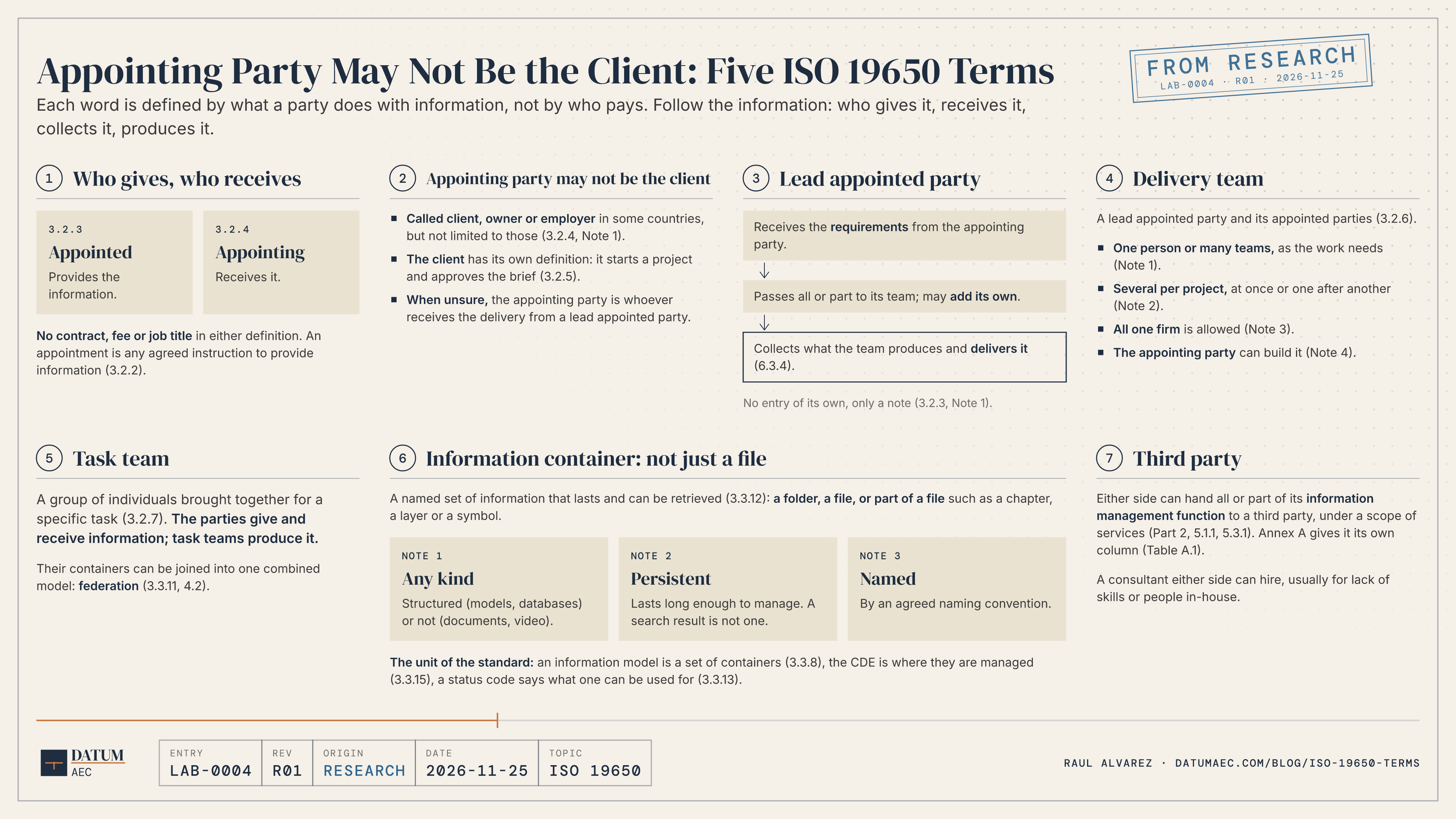
A clause says the appointing party shall do something. Who is that? Most people would say the client, and often they are right. But the word is defined by what a party does with information, not by who pays, and that difference decides who owes what to whom.
ISO 19650 is built on a handful of words: appointing party, lead appointed party, delivery team, task team and information container. Four of the five are defined in Part 1 of the standard (ISO 19650-1:2018, clause 3). The fifth, lead appointed party, appears only in a note. The other parts build on them. Here is what each word means in the standard, and how that differs from what most people think.
The roles are defined by who gives and who receives information
The two basic roles are defined as a pair. The appointed party provides information about works, goods or services; the appointing party receives it (ISO 19650-1, clauses 3.2.3 and 3.2.4). Neither definition mentions a contract, a fee or a job title. Both apply whether or not a formal appointment exists, because an appointment is any agreed instruction to provide information (clause 3.2.2; clauses 3.2.3 and 3.2.4, Note 2). When does that instruction make you follow the standard? See What Is ISO 19650?.
Appointing party: not another word for client
Part 1 notes that some countries call the appointing party the client, owner or employer, but that it is not limited to those functions (clause 3.2.4, Note 1). The client gets a definition of its own: the actor who starts a project and approves the brief (clause 3.2.5).
When unsure, follow the information: the appointing party is whoever receives the delivery from a lead appointed party.
Lead appointed party: the term with no definition of its own
Part 1 has no entry for lead appointed party. It appears only in a note under appointed party: each delivery team should have one, and it can be the same organization as one of the task teams (clause 3.2.3, Note 1).
Its job is set out in clause 6.3.4. It receives the requirements from the appointing party, may pass all or part of them to its own team and add requirements of its own, collects what the team produces and delivers it to the appointing party. Information reaches the appointing party through it.
Delivery team: can be one person
A delivery team is a lead appointed party and its appointed parties (clause 3.2.6). Its notes do most of the work:
- It can be one person or many teams. One person can do all the work, or many task teams can work in layers. Its size depends on the work (Note 1).
- A project can have several. More than one delivery team can work on the same asset (a building, road or bridge) or project, at the same time or one after another (Note 2).
- It can all be one firm. Its task teams can all come from inside the lead appointed party's own organization (Note 3).
- The appointing party can build it. The appointing party can put the team together, instead of the lead appointed party (Note 4).
Task team: the people who produce the information
A task team is a group of individuals brought together for a specific task (clause 3.2.7). The parties above give and receive information; task teams produce it. Their containers (named sets of information, explained below) can be joined into one combined information model. Part 1 calls this federation (clauses 3.3.11 and 4.2).
Information container: not just a file
An information container is a named set of information that lasts and can be retrieved from a file, a system or an application's storage (clause 3.3.12). Part 1's examples run from a folder, to a file such as a model, document or schedule, down to part of a file: a chapter, a layer, a symbol.
Its notes add three things:
- Structured or unstructured. Models, schedules and databases are structured; documents, video clips and sound recordings are unstructured (Note 1).
- Persistent. It stays around long enough to need managing. Something that only exists for a moment, like a search result, is not a container (Note 2).
- Named. Its name follows an agreed naming convention (Note 3).
The rest of the standard uses the container as its unit. An information model is a set of containers (clause 3.3.8), a common data environment (CDE) is the agreed place where each container is collected, managed and shared (clause 3.3.15), and a status code is a label that says what a container's content can be used for (clause 3.3.13).
Third party: help either side can hire
Part 2 names one more party that neither Part 1 nor Part 2 defines. The information management function is the job of managing the project's information. Part 2's first choice is for each side to give it to people from its own firm: the appointing party, and the prospective lead appointed party (a firm bidding to become the lead appointed party). As an alternative, either side can hand all or part of the job to a third party, under a scope of services (ISO 19650-2, clauses 5.1.1 and 5.3.1). Part 2 lists the third party apart from the appointed parties. The responsibility table in Annex A gives it its own column (Table A.1).
Even without a definition, I think the meaning is clear. A third party is a consultant that either side can hire to help with its information management. Usually that is because it does not have the skills or the people to do it in-house.
Back to the clause
When a clause says the appointing party shall do something, do not look for the client. Look for who receives the information. The same test works for every word here: ask who gives information, who receives it, who collects it, and who produces it. The job title and the contract come second.
Claude helped me research and draft this post. The judgment and the voice are mine.
VIDEO
Transcript
A clause says the appointing party shall do something. Who is that? Most people would say the client, and often they are right.
But the word is defined by what a party does with information, not by who pays, and that difference decides who owes what to whom.
ISO 19650 is built on a handful of words: appointing party, lead appointed party, delivery team, task team and information container. Four are defined in Part one, clause three. The fifth, lead appointed party, appears only in a note. The other parts build on them.
Here is what each word means in the standard, and how that differs from what most people think. First, how the roles are defined. Then the five words, one by one. And last, the third party.
The roles are defined by who gives and who receives information. The two basic roles are defined as a pair. The appointed party provides information about works, goods or services. The appointing party receives it. That is Part one, clauses three point two point three and three point two point four.
Neither definition mentions a contract, a fee or a job title. Both apply whether or not a formal appointment exists, because an appointment is any agreed instruction to provide information. That is clause three point two point two, and note two of both definitions.
When does that instruction make you follow the standard? See the post, What Is ISO 19650. The link is in the description.
Appointing party: not another word for client. Part one notes that some countries call the appointing party the client, owner or employer, but that it is not limited to those functions. That is clause three point two point four, note one. The client gets a definition of its own: the actor who starts a project and approves the brief. That is clause three point two point five.
When unsure, follow the information: the appointing party is whoever receives the delivery from a lead appointed party.
Lead appointed party: the term with no definition of its own. Part one has no entry for lead appointed party. It appears only in a note under appointed party: each delivery team should have one, and it can be the same organization as one of the task teams. That is clause three point two point three, note one.
Its job is set out in clause six point three point four. It receives the requirements from the appointing party, may pass all or part of them to its own team and add requirements of its own, collects what the team produces and delivers it to the appointing party. Information reaches the appointing party through it.
Delivery team: can be one person. A delivery team is a lead appointed party and its appointed parties. That is clause three point two point six. Its notes do most of the work.
It can be one person or many teams. One person can do all the work, or many task teams can work in layers. Its size depends on the work. That is note one. A project can have several. More than one delivery team can work on the same asset, a building, road or bridge, or project, at the same time or one after another. That is note two. It can all be one firm. Its task teams can all come from inside the lead appointed party's own organization. That is note three. And the appointing party can build it. The appointing party can put the team together, instead of the lead appointed party. That is note four.
Task team: the people who produce the information. A task team is a group of individuals brought together for a specific task. That is clause three point two point seven. The parties above give and receive information; task teams produce it.
Their containers, named sets of information explained next, can be joined into one combined information model. Part one calls this federation. That is clauses three point three point eleven and four point two.
Information container: not just a file. An information container is a named set of information that lasts and can be retrieved from a file, a system or an application's storage. That is clause three point three point twelve.
Part one's examples run from a folder, to a file such as a model, document or schedule, down to part of a file: a chapter, a layer, a symbol.
Its notes add three things. First, structured or unstructured: models, schedules and databases are structured; documents, video clips and sound recordings are unstructured. That is note one. Second, persistent: it stays around long enough to need managing. Something that only exists for a moment, like a search result, is not a container. That is note two. Third, named: its name follows an agreed naming convention. That is note three.
The rest of the standard uses the container as its unit. An information model is a set of containers. That is clause three point three point eight. A common data environment, or CDE, is the agreed place where each container is collected, managed and shared. Clause three point three point fifteen. And a status code is a label that says what a container's content can be used for. Clause three point three point thirteen.
Third party: help either side can hire. Part two names one more party that neither Part one nor Part two defines.
The information management function is the job of managing the project's information. Part two's first choice is for each side to give it to people from its own firm: the appointing party, and the prospective lead appointed party, a firm bidding to become the lead appointed party. As an alternative, either side can hand all or part of the job to a third party, under a scope of services. That is Part two, clauses five point one point one and five point three point one.
Part two lists the third party apart from the appointed parties. The responsibility table in Annex A gives it its own column. That is Table A point one.
Even without a definition, I think the meaning is clear. A third party is a consultant that either side can hire to help with its information management. Usually that is because it does not have the skills or the people to do it in-house.
When a clause says the appointing party shall do something, do not look for the client. Look for who receives the information.
The same test works for every word here: ask who gives information, who receives it, who collects it, and who produces it.
The job title and the contract come second. The full post is on datumaec.com, and the link is in the description. Claude helped me research and draft this post. The judgment and the writing are mine. This is Datum AEC, an open lab by Raul Alvarez.