What Is ISO 19650? The Six Parts and When You Must Follow It
- Entry
- LAB-0003
- Rev
- R01
- Origin
- Research
- Date
- 2026-11-19
- Topic
- ISO 19650
Raul Alvarez · Founder, Datum AEC · November 19, 2026 · Updated November 19, 2026
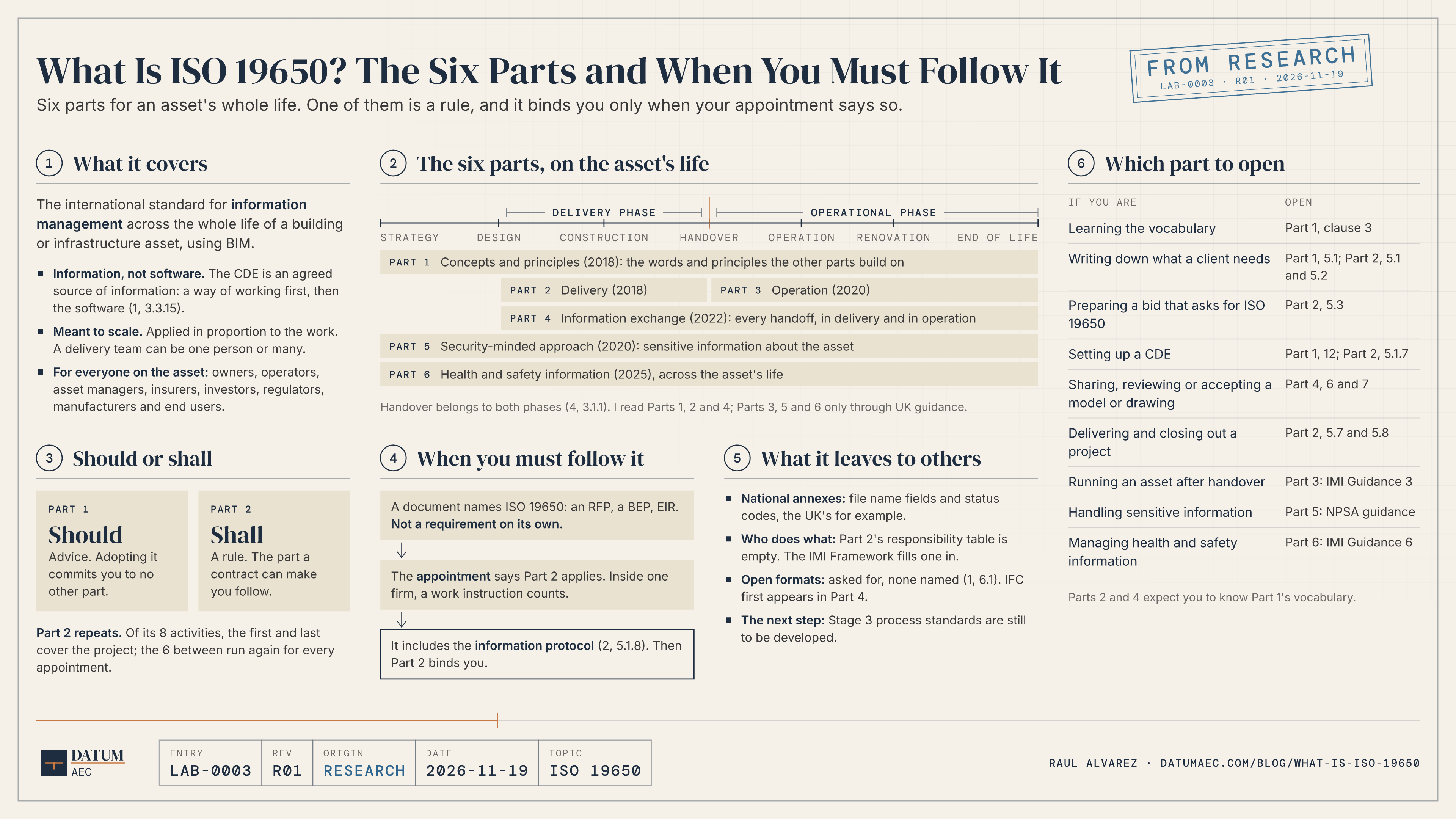
A request for proposal (RFP), a BIM execution plan (BEP) or a job post says the work must follow ISO 19650. What do you actually have to do? First, what it is. ISO 19650 is the international standard for information management across the whole life cycle of a building or infrastructure asset using building information modelling (BIM). It gives everyone who designs, builds, owns and operates an asset one consistent workflow: to establish, validate and approve requirements; to deliver, transfer and reuse information; to collaborate and coordinate in a common data environment (CDE) that acts as the single source of truth; and to manage projects from initial planning, through design and construction, to operations and finally demolition.
What you have to do depends on what your contract says. This guide maps the parts, shows which part you must follow and when, and ends with a table for finding the part that answers the question in front of you.
What ISO 19650 covers: the whole life of an asset
Part 1 sets the scope wide on purpose: from the first strategic decisions to the end of an asset's life, with design, construction, operation, maintenance, repair and renovation in between, for any built asset of any size (ISO 19650-1, clause 1). Its intended readers go well beyond designers and contractors: owners, operators, asset managers, insurers, investors, regulators, manufacturers and end users (Introduction).
Two things follow from that scope.
- It is about information, not software. The standard sees the CDE as an agreed source of information: first a way of working, then the software that supports it (ISO 19650-1, clause 3.3.15).
- It is meant to scale. Part 1 asks, more than once, to be applied in proportion to the size and complexity of the work, and a delivery team can be one person or many.
The six parts of ISO 19650 and what each covers
Each part covers one area of the work.
| Part | Covers | What it tells you |
|---|---|---|
| ISO 19650-1:2018 | Concepts and principles | What do the words mean, and which principles hold the series together? |
| ISO 19650-2:2018 | Delivery phase | How is information managed while an asset is designed and built? |
| ISO 19650-3:2020 | Operational phase | How is information managed while the asset is in use? |
| ISO 19650-4:2022 | Information exchange | What has to happen each time information passes from one team to another? |
| ISO 19650-5:2020 | Security-minded approach | How is sensitive information about an asset protected? |
| ISO 19650-6:2025 | Health and safety | How is health and safety information managed across the asset's life? |
Two things the table does not show:
- Part 4 works in delivery and in operation. It applies to any exchange during delivery and to any event in operation that calls for one (ISO 19650-4, clause 1). Handover is the one moment that belongs to both phases: Part 4 notes it can be seen as a delivery stage and as an event in operation that calls for an exchange (clause 3.1.1).
- Part 4 ties every exchange to Part 5. It lists Part 5 as indispensable to its own use and requires every exchange to run under the appropriate security arrangements (ISO 19650-4, clauses 2 and 5.1.3).
A note on my sources: I have read Parts 1, 2 and 4. For Parts 3 and 6 I have read only the UK guidance that supports them, from the IMI Framework (formerly the UK BIM Framework), the UK's guidance for applying ISO 19650, published by BSI and nima. For Part 5 the UK guidance comes not from the IMI Framework but from the National Protective Security Authority (NPSA, formerly CPNI), the UK government's authority on protective security; I have read only the IMI Framework's summary.
Should or shall: which part is advice and which is a rule
The verbs tell you which is which: "should" is advice, "shall" is a rule.
- Part 1 recommends. It writes "should" throughout, and adopting it does not commit you to Part 2 or any other part (Introduction).
- Part 2 requires. It sets out a management process and writes every requirement as "shall" (ISO 19650-2, clause 1). It is the part a contract can make you follow. Parts 3 and 4 also use "shall"; Part 2 is the one this guide follows.
- Most of Part 2 repeats for each appointment. Its process has eight activities. The first, assessment and need, and the last, close-out, cover the project as a whole; the six between them repeat for each appointment, whatever the project stage (clause 4 and Figure 3; IMI Framework, Guidance 2, § 1.2). A project with five appointments runs those six five times.
- "Shall consider" is softer than it sounds. Part 2 uses it for a list of items the person must think about carefully, and says that on a simple project several items may take moments or not apply at all (Introduction 0.1). Part 4 uses the same construction.
You must follow ISO 19650 only when the appointment says so
Even Part 2's "shall" is conditional. Part 2 is available to any appointing party (the party that receives the information, often the client), but it applies to a project only when the appointment (an agreed instruction to provide information, formal or not) says it does (ISO 19650-2, Introduction 0.1; ISO 19650-1, clause 3.2.2). Compliance is a matter of the appointment, not something that happens automatically.
The UK guidance goes further. It says that without an information protocol, the part of the appointment that sets the information management obligations, neither party has a clear obligation to comply with Part 2 or Part 3, even when other ISO 19650 documents, such as exchange information requirements (EIR), have been produced (IMI Framework, Guidance E, § 1.7). Part 2 requires the appointing party to set up that protocol and include it in every appointment (clause 5.1.8) and lists the matters it must cover, but supplies no wording for it. The UK publishes two templates for it, one for each phase.
Two consequences:
- An internal instruction counts. Inside one firm, Part 2 lets an internal work instruction count as the appointment (ISO 19650-2, clause 4, Note 3).
- A document that names ISO 19650 is not a requirement to follow it. To know whether the standard applies to your work, read the appointment and look for the protocol.
What the series leaves to others
ISO 19650 does not cover everything. You will find three of these elsewhere; the fourth does not exist yet:
- National annexes. Part 2 says some standards needed to implement it are not suitable for an international standard, and encourages national bodies to provide them (Introduction 0.2). The UK's national annexes, for example, set the fields of an information container's (file's) name, and the codes for its status.
- Who does what. Part 2's Annex A is a responsibility table of 40 activities and four parties, and every cell is empty (Table A.1). The IMI Framework publishes a filled-in version.
- Open formats. Part 1 asks for open standards whenever possible and names none (ISO 19650-1, clause 6.1). Of the parts I have read, IFC, the open format for exchanging models, is first named in Part 4.
- The next step. Part 1 places the series at what it calls Stage 2 maturity (often called BIM Level 2), and marks the process standards for Stage 3 as still to be developed (ISO 19650-1, clause 4.2 and Figure 1).
Which part of ISO 19650 to open for your question
Find your situation, then open the part and clause beside it.
| If you are... | Open | Start at |
|---|---|---|
| Learning the vocabulary (appointing party, delivery team, information container) | Part 1 | Clause 3 |
| Writing down what a client needs | Part 1, then Part 2 | Part 1 clause 5.1; Part 2 clauses 5.1 and 5.2 |
| Preparing a bid that asks for ISO 19650 | Part 2 | Clause 5.3 |
| Setting up a CDE | Part 1, then Part 2 | Part 1 clause 12; Part 2 clause 5.1.7 |
| Sharing, reviewing or accepting a model or drawing | Part 4 | Clauses 6 and 7 |
| Delivering the information model and closing out a project | Part 2 | Clauses 5.7 and 5.8 |
| Running or maintaining an asset after handover | Part 3 | IMI Framework, Guidance 3 |
| Handling sensitive information | Part 5 | NPSA guidance; IMI Framework, Guidance 1, § 3.5 |
| Managing health and safety information | Part 6 | IMI Framework, Guidance 6 |
Parts 2 and 4 both build on Part 1's vocabulary (ISO 19650-2, clause 3; ISO 19650-4, clause 2), so they expect you to know Part 1.
The next post in this series covers the words the parts are built on: appointing party, lead appointed party, delivery team, task team and information container.
Claude helped me research and draft this post. The judgment and the voice are mine.
VIDEO
Transcript
A request for proposal, a BIM execution plan or a job post says the work must follow ISO 19650. What do you actually have to do?
What you have to do depends on what your contract says. This video maps the parts, shows which part you must follow and when, and ends with a table for finding the part that answers the question in front of you.
First, what ISO 19650 covers. Then, the six parts, which part is advice and which is a rule, and when you must follow it. And last, what the series leaves to others, and which part to open for your question.
First, what it is. ISO 19650 is the international standard for information management across the whole life cycle of a building or infrastructure asset using building information modelling, or BIM.
It gives everyone who designs, builds, owns and operates an asset one consistent workflow. To establish, validate and approve requirements. To deliver, transfer and reuse information. To collaborate and coordinate in a common data environment, or CDE, that acts as the single source of truth. And to manage projects from initial planning, through design and construction, to operations and finally demolition.
What ISO 19650 covers: the whole life of an asset. Part one sets the scope wide on purpose: from the first strategic decisions to the end of an asset's life, with design, construction, operation, maintenance, repair and renovation in between, for any built asset of any size.
Its intended readers go well beyond designers and contractors: owners, operators, asset managers, insurers, investors, regulators, manufacturers and end users.
Two things follow from that scope. It is about information, not software. The standard sees the CDE as an agreed source of information: first a way of working, then the software that supports it.
It is meant to scale. Part one asks, more than once, to be applied in proportion to the size and complexity of the work, and a delivery team can be one person or many.
The six parts of ISO 19650, and what each covers. Each part covers one area of the work. Part one, concepts and principles: what do the words mean, and which principles hold the series together? Part two, the delivery phase: how is information managed while an asset is designed and built? Part three, the operational phase: how is information managed while the asset is in use?
Part four, information exchange: what has to happen each time information passes from one team to another? Part five, the security-minded approach: how is sensitive information about an asset protected? And Part six, health and safety: how is health and safety information managed across the asset's life?
Two things that list does not show. Part four works in delivery and in operation. It applies to any exchange during delivery, and to any event in operation that calls for one. Handover is the one moment that belongs to both phases. Part four notes it can be seen as a delivery stage, and as an event in operation that calls for an exchange.
Part four ties every exchange to Part five. It lists Part five as indispensable to its own use, and requires every exchange to run under the appropriate security arrangements.
A note on my sources. I have read Parts one, two and four. For Parts three and six I have read only the UK guidance that supports them, from the IMI Framework, formerly the UK BIM Framework. It is the UK's guidance for applying ISO 19650, published by BSI and nima. For Part five, the UK guidance comes not from the IMI Framework but from the National Protective Security Authority, formerly CPNI, the UK government's authority on protective security. I have read only the IMI Framework's summary.
Should or shall: which part is advice, and which is a rule. The verbs tell you which is which. Should is advice. Shall is a rule. Part one recommends. It writes should throughout, and adopting it does not commit you to Part two or any other part. Part two requires. It sets out a management process and writes every requirement as shall. It is the part a contract can make you follow. Parts three and four also use shall. Part two is the one this video follows.
Most of Part two repeats for each appointment. Its process has eight activities. The first, assessment and need, and the last, close-out, cover the project as a whole. The six between them repeat for each appointment, whatever the project stage. A project with five appointments runs those six five times.
Shall consider is softer than it sounds. Part two uses it for a list of items the person must think about carefully, and says that on a simple project several items may take moments, or not apply at all. Part four uses the same construction.
You must follow ISO 19650 only when the appointment says so. Even Part two's shall is conditional.
Part two is available to any appointing party, the party that receives the information, often the client. But it applies to a project only when the appointment says it does. An appointment is an agreed instruction to provide information, formal or not. Compliance is a matter of the appointment, not something that happens automatically.
The UK guidance goes further. It says that without an information protocol, the part of the appointment that sets the information management obligations, neither party has a clear obligation to comply with Part two or Part three, even when other ISO 19650 documents, such as exchange information requirements, have been produced.
Part two requires the appointing party to set up that protocol and include it in every appointment, and lists the matters it must cover, but supplies no wording for it. The UK publishes two templates for it, one for each phase.
Two consequences. An internal instruction counts: inside one firm, Part two lets an internal work instruction count as the appointment. And a document that names ISO 19650 is not a requirement to follow it. To know whether the standard applies to your work, read the appointment and look for the protocol.
What the series leaves to others. ISO 19650 does not cover everything. You will find three of these elsewhere; the fourth does not exist yet.
National annexes. Part two says some standards needed to implement it are not suitable for an international standard, and encourages national bodies to provide them. The UK's national annexes, for example, set the fields of an information container's name, that is, a file's name, and the codes for its status.
Who does what. Part two's Annex A is a responsibility table of forty activities and four parties, and every cell is empty. The IMI Framework publishes a filled-in version.
Open formats. Part one asks for open standards whenever possible, and names none. Of the parts I have read, IFC, the open format for exchanging models, is first named in Part four.
The next step. Part one places the series at what it calls Stage two maturity, often called BIM Level two, and marks the process standards for Stage three as still to be developed.
Which part of ISO 19650 to open for your question. Find your situation, then open the part and clause beside it. Learning the vocabulary, like appointing party, delivery team and information container: Part one, clause three. Writing down what a client needs: Part one, clause five point one, then Part two, clauses five point one and five point two. Preparing a bid that asks for ISO 19650: Part two, clause five point three.
Setting up a CDE: Part one, clause twelve, then Part two, clause five point one point seven. Sharing, reviewing or accepting a model or drawing: Part four, clauses six and seven. Delivering the information model and closing out a project: Part two, clauses five point seven and five point eight.
Running or maintaining an asset after handover: Part three, through the IMI Framework's Guidance three. Handling sensitive information: Part five, through the National Protective Security Authority's guidance, and the IMI Framework's Guidance one, section three point five. Managing health and safety information: Part six, through the IMI Framework's Guidance six.
Parts two and four both build on Part one's vocabulary, so they expect you to know Part one.
The next post in this series covers the words the parts are built on: appointing party, lead appointed party, delivery team, task team and information container. The full post is on datumaec.com, and the link is in the description. Claude helped me research and draft this post. The judgment and the voice are mine. This is Datum AEC, an open lab by Raul Alvarez.
RELATED
from Researchnote · UPDATED NOV 2026
Appointing Party May Not Be the Client: Five ISO 19650 Termsfrom Researchguide · JUL 2026
ISO 19650 for Small Firms: No BIM Manager Requiredfrom Developmentguide · JUL 2026
Revit Template Setup: What a Structured Template Containsfrom Researchguide · JUL 2026
Switching from AutoCAD to Revit: Start with Structure