What Is a Second Brain? I Asked Mine and It Had No Answer
- Entry
- LAB-0001
- Rev
- R01
- Origin
- Research
- Date
- 2026-11-05
- Topic
- Second brains
Raul Alvarez · Founder, Datum AEC · November 5, 2026
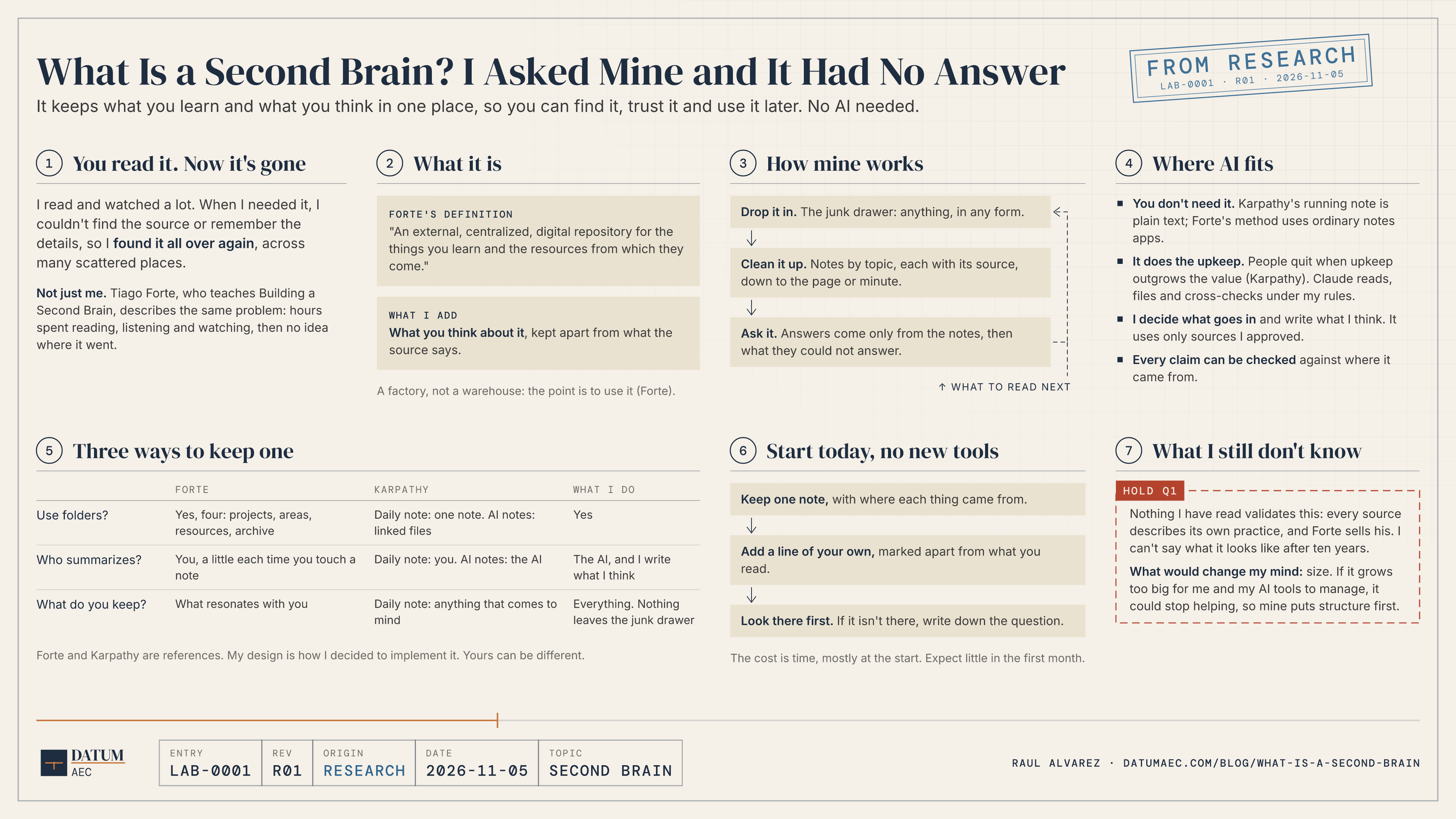
Before writing this post, I had Claude, the AI I work with, search my second brain for a simple question: what is a second brain?
It came back with one passing line from a video about something else. My own system could not explain itself.
So here is the answer it should have had. A second brain is a system that keeps what you learn and what you think in one place, so you can find it, trust it and use it later. You don't need to be technical to keep one, and you don't need AI.
That gap turned out to be useful, and I'll come back to it. First, why anyone would bother.
You read it. Now you can't find it.
I used to read and watch a lot, about things that interested me and things I thought might help me one day. When that day came, I couldn't find the source and I couldn't remember the details. So I spent more time finding it all over again, across many scattered places. It happened again and again. I wanted a way out of that hole: one place, with some structure, where I could go and look.
I'm not alone in this. Tiago Forte, who teaches a method called Building a Second Brain, describes the same problem: hours every year spent reading, listening and watching, and then no idea where it all went when you need it. His own notes started with medical records. At 22, with an illness his doctors could not pin down, he scanned his records and sorted them by date, specialty and doctor. Later, he searched years of those notes and found almost a dozen things that helped.
What is a second brain, exactly?
Forte defines it as "an external, centralized, digital repository for the things you learn and the resources from which they come."
In plain words: one place outside your head, on your computer or phone, for what you learn and where you learned it.
I add one thing to that: what you think about it. In mine, what a source says and what I think stay apart, so later I can tell "the standard says this" from "I think the standard is wrong."
Forte's own manifesto says it takes over the remembering so you are free to imagine and create, and his picture is a factory, not a warehouse: the point is not to store things, it is to use them.
How one works: drop it in, clean it up, ask it
There are many ways to build one. Mine has three steps.
Drop it in. I keep a folder I call the junk drawer. Articles, PDFs, video transcripts, a paragraph I typed. Anything goes, in any form, because if saving something takes effort, I'll stop doing it.
Clean it up. Each thing then gets read and cut down to what matters, in notes organized by topic. Every note says where it came from, down to the page or the minute. When two sources disagree, I keep both and write down that they disagree.
Ask it. When I have a question, the answer comes from those notes, and it ends by saying what the notes could not answer. That list tells me what to read next, which is how it gets better by being asked.
What happened when I asked mine
The missing answer became the next thing to read. I had Claude find the originals and add them: Forte's own guide, and two pieces by Andrej Karpathy, a founding member of OpenAI and former Director of AI at Tesla.
They don't agree. Karpathy doesn't even use the term. He keeps his daily notes in one long running note, and separately describes a set of linked notes that an AI writes and keeps up.
| Forte | Karpathy | What I do | |
|---|---|---|---|
| Use folders? | Yes, four: projects, areas, resources, archive | Daily note: no, one note. AI notes: a folder of linked files | Yes |
| Who does the summarizing? | You, a little each time you touch a note | Daily note: you. AI notes: the AI | The AI, and I write what I think |
| What do you keep? | What resonates with you | Daily note: anything that comes to mind | Everything. Nothing leaves the junk drawer |
Forte and Karpathy are references. My design is how I decided to implement it. Yours can be different.
The reading also turned up something small. In Forte's guide, one diagram ends with "Delete it," where the text says to archive the item or not save it. That is the kind of thing my second brain is built to catch.
I use the same habit in my daily work. Recently I was checking some of my templates against international standards: a collaboration protocol, a coordination protocol and a BIM execution plan, which are documents that tell a project team how to work together. It let me find and fix gaps quickly, consulting only sources I had approved. It also caught places where the same thing was worded differently across documents, and it kept a record of my decisions.
It helps over time too. When I develop my Revit project template and families (Revit is building design software), I set rules and check new work against them, so what I do today is consistent with what I did a year ago. When a rule changes, I can update what depends on it with repeatable, automated fixes.
To be clear about the timeline: this version of my second brain is about two months old. I had been exploring the idea and testing it before that.
Where AI fits
You don't need it. Karpathy's running note is plain text, and Forte's method is built around ordinary notes apps.
I use it because of the chore that makes people give up. Karpathy says people abandon these systems because the upkeep grows faster than the value. In mine, Claude does most of the reading, filing and cross-checking, under rules I set. I decide what goes in, and I write what I think. My second brain also feeds the AI agents I use, so they understand me better and help me with my goals.
It limits the AI to sources I approved, and lets me check every claim against where it came from.
What it costs, and how to start
The real cost is time and effort, mostly at the start. A second brain forces you to process what you read instead of just consuming it. I think that pays off long term, and it might even save time later. Either way, I get better structure, one place to look, and better work with AI. I was already putting in the effort, just inefficiently, so why not? Don't expect much in the first month, though. The value comes from what builds up.
This is not for everyone, especially if you are not currently studying, learning or developing your knowledge.
If you are, you can start today with no new tools:
- Keep one note on your phone or computer. When something is worth keeping, add it at the top, with where it came from.
- Add a line of your own. Say what you think, marked so you can tell it from what you read.
- Look there first. When you need something, search that note. If it isn't there, write down the question. That is what to go and find next.
Now and then, scroll down and move what still matters back to the top. The one note and the scrolling are Karpathy's habit, and the other two come from how I keep mine.
What I still don't know
Back to the question I started with. Ask my second brain now and it can answer: the definition at the top of this post is built from what it holds, plus the part about what I think. Then, as always, it says what is still missing.
Nothing I have read validates any of this. Every source is someone describing their own practice, and Forte also sells his. I also can't tell you what this looks like after ten years.
What would change my mind is size. If the information grows too big for me and my AI tools to manage, my second brain could stop being helpful. That is why my version puts structure first: an index, separate topics, a short description of each one, and the links between them.
If you keep one, or tried one and gave up, I'd like to hear what happened.
Claude helped me research and draft this post. The judgment and the voice are mine.
VIDEO
Transcript
What is a second brain? Before writing this post, I had Claude, the AI I work with, search my second brain for that simple question.
It came back with one passing line from a video about something else. My own system could not explain itself.
So here is the answer it should have had. A second brain is a system that keeps what you learn and what you think in one place, so you can find it, trust it and use it later. You don't need to be technical to keep one, and you don't need AI.
That gap turned out to be useful, and I'll come back to it. First, why anyone would bother. Then, what one is, how it works, and what happened when I asked mine. And last, where AI fits, what it costs, how to start, and what I still don't know.
I used to read and watch a lot, about things that interested me and things I thought might help me one day. When that day came, I couldn't find the source and I couldn't remember the details. So I spent more time finding it all over again, across many scattered places. It happened again and again.
I wanted a way out of that hole: one place, with some structure, where I could go and look.
I'm not alone in this. Tiago Forte, who teaches a method called Building a Second Brain, describes the same problem: hours every year spent reading, listening and watching, and then no idea where it all went when you need it.
His own notes started with medical records. At twenty-two, with an illness his doctors could not pin down, he scanned his records and sorted them by date, specialty and doctor. Later, he searched years of those notes and found almost a dozen things that helped.
Forte defines it as an external, centralized, digital repository for the things you learn and the resources from which they come.
In plain words: one place outside your head, on your computer or phone, for what you learn and where you learned it.
I add one thing to that: what you think about it. In mine, what a source says and what I think stay apart, so later I can tell, the standard says this, from, I think the standard is wrong.
Forte's own manifesto says it takes over the remembering so you are free to imagine and create. And his picture is a factory, not a warehouse: the point is not to store things, it is to use them.
There are many ways to build one. Mine has three steps. Drop it in. Clean it up. And ask it.
Drop it in. I keep a folder I call the junk drawer. Articles, PDFs, video transcripts, a paragraph I typed. Anything goes, in any form, because if saving something takes effort, I'll stop doing it.
Clean it up. Each thing then gets read and cut down to what matters, in notes organized by topic. Every note says where it came from, down to the page or the minute. When two sources disagree, I keep both and write down that they disagree.
Ask it. When I have a question, the answer comes from those notes, and it ends by saying what the notes could not answer. That list tells me what to read next, which is how it gets better by being asked.
The missing answer became the next thing to read. I had Claude find the originals and add them: Forte's own guide, and two pieces by Andrej Karpathy, a founding member of OpenAI and former Director of AI at Tesla.
They don't agree. Karpathy doesn't even use the term. He keeps his daily notes in one long running note, and separately describes a set of linked notes that an AI writes and keeps up.
Do you use folders? For Forte, yes, four: projects, areas, resources and archive. Karpathy's daily note, no, it's one note, and his AI notes are a folder of linked files. And I do use folders.
Who does the summarizing? For Forte, you do, a little each time you touch a note. For Karpathy, you do in the daily note, and the AI does in the AI notes. In mine, the AI does, and I write what I think.
What do you keep? Forte keeps what resonates with you. Karpathy's daily note keeps anything that comes to mind. And me? Everything. Nothing leaves the junk drawer.
Forte and Karpathy are references. My design is how I decided to implement it. Yours can be different.
The reading also turned up something small. In Forte's guide, one diagram ends with, delete it, where the text says to archive the item or not save it. That is the kind of thing my second brain is built to catch.
I use the same habit in my daily work. Recently I was checking some of my templates against international standards: a collaboration protocol, a coordination protocol and a BIM execution plan, which are documents that tell a project team how to work together.
It let me find and fix gaps quickly, consulting only sources I had approved. It also caught places where the same thing was worded differently across documents, and it kept a record of my decisions.
It helps over time too. When I develop my Revit project template and families, and Revit is building design software, I set rules and check new work against them, so what I do today is consistent with what I did a year ago. When a rule changes, I can update what depends on it with repeatable, automated fixes.
To be clear about the timeline: this version of my second brain is about two months old. I had been exploring the idea and testing it before that.
You don't need it. Karpathy's running note is plain text, and Forte's method is built around ordinary notes apps.
I use it because of the chore that makes people give up. Karpathy says people abandon these systems because the upkeep grows faster than the value. In mine, Claude does most of the reading, filing and cross-checking, under rules I set. I decide what goes in, and I write what I think.
My second brain also feeds the AI agents I use, so they understand me better and help me with my goals. It limits the AI to sources I approved, and lets me check every claim against where it came from.
The real cost is time and effort, mostly at the start. A second brain forces you to process what you read instead of just consuming it. I think that pays off long term, and it might even save time later.
Either way, I get better structure, one place to look, and better work with AI. I was already putting in the effort, just inefficiently, so why not? Don't expect much in the first month, though. The value comes from what builds up.
This is not for everyone, especially if you are not currently studying, learning or developing your knowledge.
If you are, you can start today with no new tools. One. Keep one note on your phone or computer. When something is worth keeping, add it at the top, with where it came from.
Two. Add a line of your own. Say what you think, marked so you can tell it from what you read.
Three. Look there first. When you need something, search that note. If it isn't there, write down the question. That is what to go and find next.
Now and then, scroll down and move what still matters back to the top. The one note and the scrolling are Karpathy's habit, and the other two come from how I keep mine.
Back to the question I started with. Ask my second brain now and it can answer: the definition at the top of this post is built from what it holds, plus the part about what I think. Then, as always, it says what is still missing.
Nothing I have read validates any of this. Every source is someone describing their own practice, and Forte also sells his. I also can't tell you what this looks like after ten years.
What would change my mind is size. If the information grows too big for me and my AI tools to manage, my second brain could stop being helpful. That is why my version puts structure first: an index, separate topics, a short description of each one, and the links between them.
If you keep one, or tried one and gave up, I'd like to hear what happened. The full post is on datumaec.com, and the link is in the description. Claude helped me research and draft this post. The judgment and the writing voice are mine. This is Datum AEC, an open lab by Raul Alvarez.