What Is a Second Brain For? Daily Work, AI and a Lab Diary
- Entry
- LAB-0002
- Rev
- R01
- Origin
- Development
- Date
- 2026-11-06
- Topic
- Second brains
Raul Alvarez · Founder, Datum AEC · November 6, 2026
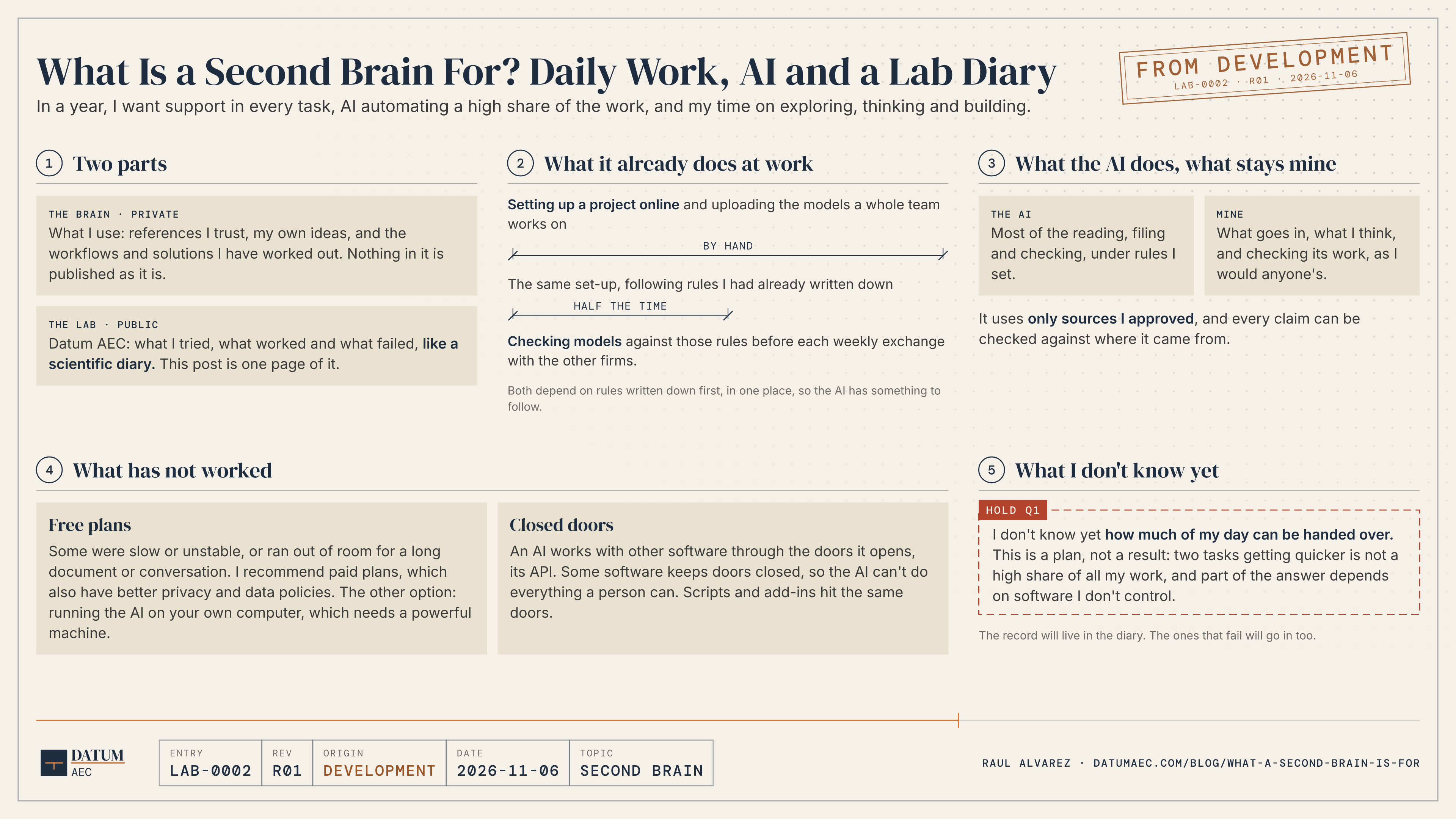
Every week, before the building models I manage go out to the other firms on a project, they have to be checked against a set of rules and fixed where they are wrong. My second brain and an AI now help me do that.
That is a small version of where this is going. A year from now, I want my second brain to support me in every task I do, with AI plugged in and automating a high share of the work, so my time goes to what matters to me: exploring, thinking, growing, building and innovating.
If you are new here, a second brain is a system that keeps what you learn and what you think in one place, so you can find it, trust it and use it later. I explained how mine works in What Is a Second Brain? This post is about what it is for.
Two parts: a private brain and a public lab
The brain is private. It holds what I use: references I trust, my own ideas, and the systems, workflows, procedures and solutions I have worked out. Nothing in it is published as it is. What you read here is written fresh, and the home page shows only the names of its topics and how they connect.
The lab is public. Datum AEC is its name. It holds the research and development: what I tried, what worked and what failed, like a scientific diary that helps me and others learn from it. This post is one page of that diary.
What it already does at work
In my day job I manage how the digital models of buildings are set up, checked and shared between the firms on a project. The models in these examples are made in Revit, software that many buildings are designed in. Two recent examples:
- Setting up projects. Setting up a new project online and uploading the models a whole team works on, following rules I had already written down, took me half the time it used to take by hand.
- Checking models. Before each weekly exchange with the other firms on a project, the brain and AI help me check the models against those rules, confirm what passes and correct what does not.
Both depend on the same thing. The rules were written down first, in one place, so the AI has something to follow.
What the AI does, and what stays mine
The AI does most of the reading, filing and checking, under rules I set. I decide what goes in, and I write what I think.
My second brain limits the AI to sources I approved, and lets me check every claim against where it came from. And I check its work, as I would check anyone's.
What has not worked
Here are two limits I have hit.
Free plans. Some free AI plans were slow or unstable, or ran out of room: they could not hold enough of a long document or a long conversation at once. I fully recommend paid plans, which also have better privacy and data policies. The other option is running the AI on your own computer, which needs a powerful machine.
Software that keeps some doors closed. An AI works with other software through the doors that software opens to other programs, called its API. Some software does not open all of them, so the AI cannot do everything a person can do in that software. This limit is not new with AI: traditional automation, scripts and custom add-ins (small programs built into the software) run into the same closed doors.
What I don't know yet
This is a plan, not a result. Two tasks getting quicker is not the same as a high share of all my work. I don't know yet how much of my day can be handed over, and part of that answer depends on software I don't control.
What I do know is where the record will live. The weekly check at the top of this post is one entry in the diary. The ones that fail will go in too.
If you are trying something similar, I'd like to hear what worked for you and what didn't.
Claude helped me draft this post. The judgment and the voice are mine.
VIDEO
Transcript
What is a second brain for? Every week, before the building models I manage go out to the other firms on a project, they have to be checked against a set of rules and fixed where they are wrong. My second brain and an AI now help me do that.
That is a small version of where this is going. A year from now, I want my second brain to support me in every task I do, with AI plugged in and automating a high share of the work, so my time goes to what matters to me: exploring, thinking, growing, building and innovating.
If you are new here, a second brain is a system that keeps what you learn and what you think in one place, so you can find it, trust it and use it later. I explained how mine works in the post What Is a Second Brain. The link is in the description. This post is about what it is for.
First, the two parts: a private brain and a public lab. Then, what it already does at work, and what the AI does and what stays mine. And last, what has not worked, and what I don't know yet.
The brain is private. It holds what I use: references I trust, my own ideas, and the systems, workflows, procedures and solutions I have worked out.
Nothing in it is published as it is. What you read here is written fresh, and the home page shows only the names of its topics and how they connect.
The lab is public. Datum AEC is its name. It holds the research and development: what I tried, what worked and what failed, like a scientific diary that helps me and others learn from it. This post is one page of that diary.
In my day job I manage how the digital models of buildings are set up, checked and shared between the firms on a project. The models in these examples are made in Revit, software that many buildings are designed in. Two recent examples.
Setting up projects. Setting up a new project online and uploading the models a whole team works on, following rules I had already written down, took me half the time it used to take by hand.
Checking models. Before each weekly exchange with the other firms on a project, the brain and AI help me check the models against those rules, confirm what passes and correct what does not.
Both depend on the same thing. The rules were written down first, in one place, so the AI has something to follow.
The AI does most of the reading, filing and checking, under rules I set. I decide what goes in, and I write what I think.
My second brain limits the AI to sources I approved, and lets me check every claim against where it came from. And I check its work, as I would check anyone's.
Here are two limits I have hit. Free plans. Some free AI plans were slow or unstable, or ran out of room: they could not hold enough of a long document or a long conversation at once.
I fully recommend paid plans, which also have better privacy and data policies. The other option is running the AI on your own computer, which needs a powerful machine.
Software that keeps some doors closed. An AI works with other software through the doors that software opens to other programs, called its API. Some software does not open all of them, so the AI cannot do everything a person can do in that software.
This limit is not new with AI. Traditional automation, scripts and custom add-ins, small programs built into the software, run into the same closed doors.
This is a plan, not a result. Two tasks getting quicker is not the same as a high share of all my work.
I don't know yet how much of my day can be handed over, and part of that answer depends on software I don't control.
What I do know is where the record will live. The weekly check at the top of this post is one entry in the diary. The ones that fail will go in too.
If you are trying something similar, I'd like to hear what worked for you and what didn't. The full post is on datumaec.com, and the link is in the description. Claude helped me draft this post. The judgment and the writing voice are mine. This is Datum AEC, an open lab by Raul Alvarez.